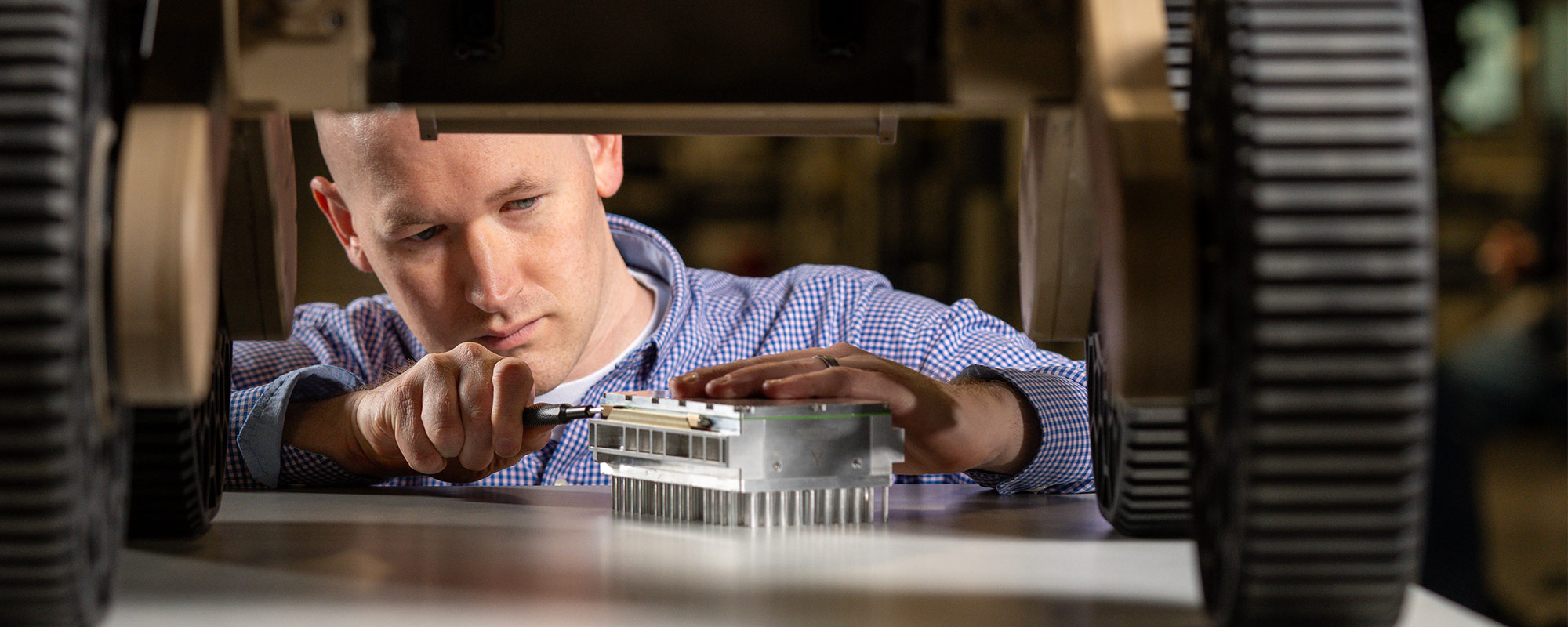
Niko always had a passion for science, technology, engineering and mathematics and mentoring those around him.
From Doodles to Disruption
SCRAM revolutionizes aerospace manufacturing with scalable robotic composites.
By Suzanne Kubler
What began as a rough sketch on the back of a napkin has evolved into a breakthrough for aerospace manufacturing. That “kernel of an idea,” as Northrop Grumman Fellow Eric Barnes calls it, became the foundation for a new approach — scalable composite robotic additive manufacturing, or SCRAM.
“It’s been an amazing journey, leading the industry and developing something completely new,” said Eric.
Eric came up with the concept when challenged with coming up with a more efficient fabricating process.
According to SCRAM Technical Program Manager David Ivankovich, what makes the system so different from traditional manufacturing is it uses advanced manufacturing techniques and automation.
“It creates a ‘factory in a cell’ which drastically reduces lead time, waste and cost,” he said. “Everything SCRAM does: cutting, hand layup, curing, trimming is typically done in many stages in a large footprint factory rather than a small box. It’s an absolute disruptor.”
The system manufactured the wingtips of the M437 aircraft, which first flew in August 2024, demonstrating the efficiencies of Northrop Grumman’s fully integrated digital ecosystem.
That ecosystem weaves the entire product lifecycle into a single digital thread, connecting our employees, suppliers and customers, and works cohesively with SCRAM.
Advanced manufacturing is rapidly changing with the integration of digital tool sets, AI and machine learning. This field is a really exciting place to be.
Perseverance Pays Off
For those incorporating SCRAM, the technology opens up an entirely new way of manufacturing for aerospace, defense and beyond.
“It’s tricky work, and it’s fun. There are so many layers, it feels almost like an art,” said Matthew Burger, a software engineer. He worked with SCRAM to design the M437’s wingtips and explained that it has been both technically demanding and creatively fulfilling.
“Advanced manufacturing is rapidly changing with the integration of digital tool sets, AI and machine learning,” said Eric. “This field is a really exciting place to be.”
Throughout Eric’s 35-year career at Northrop Grumman, he has applied cutting-edge technologies to many platforms including F/A-18, F-35, B-2, Triton, Global Hawk and others. He said creating disruptive technology in this space is invigorating. The success of SCRAM represents the high point of his career, although the process was not linear; their original patent was so complex it had to be split into six different ones.
Eric believes resilience and perseverance are key to innovation and that it requires maintaining a positive attitude, learning from failures and continuing to strive towards goals, even when faced with difficulties.
“Challenges are what make the job interesting but overcoming them to the benefit of our warfighters is what makes it meaningful,” said Eric.
SummaryTakeaways
JSS component is missing React implementation. See the developer console for more information.
Life at Northrop Grumman
Your work at Northrop Grumman makes a difference. Whether you want to design next-generation aircraft, harness digital technologies or build spacecraft that will return humanity to the moon, you’ll contribute to technology that’s transforming the world. Check out our career opportunities to see how you can help define possible.